

Infrared Film
Photography Beyond the Visible Infrared film refers to photographic film sensitized to the near-infrared portion of the electromagnetic spectrum, typically ranging between 700 and 900 nm. These films have been—and still are, to a lesser extent—available as black and white negative film, reversal film (slides), or color negative film. Legendary examples include the Kodak Professional High-Speed Infrared Film HIE 135-36 (B&W) and the Kodak Ektachrome Infrared EIR (Color Slide). Beyond industrial and scientific applications, these films were widely used in fine-art photography, gaining fame for the characteristic "Wood Effect," which renders foliage in bright, ethereal tones.
Handling: All infrared films should be handled in total darkness. This is especially critical when loading the film into the camera, as many IR emulsions feature thin anti-halation layers or can be susceptible to infrared light leaking through the plastic cartridges of modern cameras.
Current Availability: As of 2026, the Rollei Infrared 400 is the industry standard for available black and white infrared film and is readily obtainable.
Rollei Infrared 400: A Versatile Performer The Rollei Infrared 400 is a highly sensitive, hyperpanchromatic black and white film reaching into the infrared spectrum (wavelengths up to 820 nm). With a nominal sensitivity ranging from ISO 200/24° to 400/27°, it offers exceptional flexibility. Its 7.5 µm thin, silver-rich emulsion is coated on a modern, 100 µm clear polyester base, delivering high resolving power, fine grain, and excellent edge sharpness.
The Rollei Infrared is a true all-rounder: suitable for standard photography, yet highly responsive to various filters, capable of producing distinct infrared effects. To achieve the signature "Wood Effect," we recommend using infrared filters such as the 695 nm (89B) or 715 nm (88A).
In addition to dedicated infrared films, there are films with extended red sensitivity (below 780 nm) that are readily available:
-
Ilford SFX 200: Sensitivity extends up to 740 nm (ISO 200/24°)
-
Rollei Superpan 200: Based on aerial film technology with superpanchromatic sensitization, this film extends up to 750 nm (ISO 200/24°). An infrared effect is only pronounced when using a filter that blocks visible light below 715 nm (e.g., Heliopan RG 715)
-
-
Rollei Retro 80S - up to 750nm (ISO 100/21°)
-
Rollei Retro 400S - up to 730nm (ISO 400/27°)
Data sheets available for download, .pdf files
There is one film I have kept a secret from you until now. Unfortunately, it is no longer manufactured, so I purchased a few expired rolls at an auction house: the legendary Kodak High Speed Infrared Film (HIE). This iconic black-and-white film features an extreme spectral sensitivity extending from ultraviolet and visible light far into the near-infrared spectrum up to approximately 900 nm. Because it completely lacks an anti-halation layer and is coated on a crystal-clear base, it produces that world-famous, dreamlike glow (blooming or halo effect) around highlights, making it highly prized in fine-art photography.
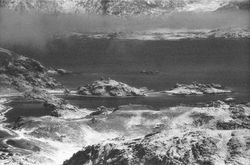
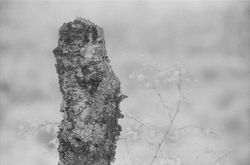
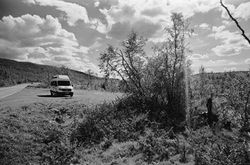
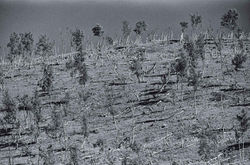
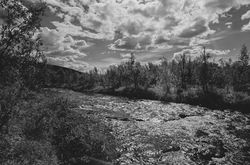
In the gallery, you can see several images I captured with this film as well as with the Rollei Infrared 400, shot using either a deep red or an IR72 infrared filter. Because Kodak HIE is incredibly light-sensitive and light can actually pipe through the felt light seal of the film cassette, the camera must be strictly protected from light leaks. For this reason, I also masked off the film confirmation window on the camera back with dark tape. I loaded my EOS 620, EOS 600, and EOS RT cameras at home in total darkness and transported them inside a changing bag for protection. Naturally, I developed the films myself in my home darkroom.
 |  |  |
|---|---|---|
 |  |  |
 |  |  |
 |  |  |
 |  |  |
 |  |  |
 |  |  |
 |